
GUT–BRAIN RESEARCH
What can the gut
tell us about
brain health?
Your gut and brain exchange signals. Neurabi brings microbiome measurements and scientific evidence together to support a clinician’s review.
In development · Pilot study in preparation.
Not yet available for clinical use.
Step 1 of 6
A whole world
lives inside you.
Your gut is home to a community of tiny living things called microorganisms. Together, they make up your gut microbiota.
Move your pointer to stir themTouch the screen to stir them
Step 2 of 6
Two organs.
One conversation.
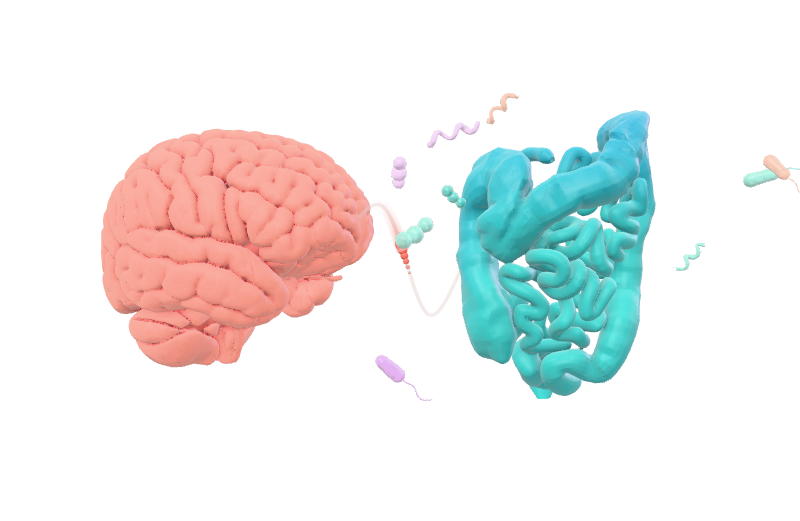
Your gut has its own network of nerve cells, sometimes called the second brain. Signals travel between it and your brain all the time. Researchers call this the gut–brain axis. Choose a route to see it.
A direct line of communication.
Nerves, including the vagus nerve, carry messages between the gut and the brain. Communication travels in both directions.
A shared conversation with the immune system.
The gut, its microorganisms and the immune system interact. Scientists are studying how these signals relate to processes in the brain.
Small molecules. Interesting questions.
Gut microorganisms help break down food and produce molecules called metabolites. Researchers are exploring how these molecules interact with the body and brain.
Step 3 of 6
When illness
changes the signals.
Each condition affects the nervous system in its own way. Choose one to see a simplified picture.
Abnormal proteins build up in the brain, and connections between nerve cells are gradually lost. This can affect memory and thinking.
Nerve cells that produce dopamine, a chemical messenger involved in movement, are gradually lost. Some people notice constipation years before movement symptoms.
The immune system damages myelin, the protective coating around nerve fibres. Messages can slow down or fail to get through.
Studies have found differences in the gut microbiome of people with these conditions. Researchers do not yet know whether they are a cause, a consequence or neither.
Understanding a connection is where research begins. Neurabi is a research project, and nothing on this website is a way to prevent, diagnose or treat a condition.
Explore the scienceStep 4 of 6
From your sample
to a clear report.
This is how Neurabi is designed to work. The prototype runs on example data today, and patients will be invited only through the pilot study.
You send your sample.
You provide a stool sample and a laboratory sequences it. Neurabi works with the measurements the laboratory produces.
Your measurements are compared.
Neurabi compares the laboratory measurements with a study reference, taking the available sample context into account. The current prototype compares 54 measurements.
Your clinician works in a separate portal.
They examine each result, the saved research and the uncertainty, then decide what to discuss with you. An AI assistant helps them look through the sources; the decisions are theirs.
Your detailed report is released.
Once reviewed, your clinician releases it to you: a summary, each result in plain language and the next steps. You can download it and compare a later sample.
Step 5 of 6
Where we are,
and what comes next.
- DONE SO FAR
A working prototype
- WE ARE HERE
Preparing the pilot
Agreeing the study protocol, laboratory arrangements and clinical input, and preparing for the required approvals.
- NEXT
Learn from a first study
- LONGER TERM
Prove it before offering it
Not yet available for clinical use.
Step 6 of 6
Where would you
like to go next?
Understanding, before everything.
Our aim is to turn complex gut microbiome information into a clear explanation you could discuss with your clinician.
What this could mean for youFor clinicians & researchersA new layer of understanding.
We’re developing a research tool to organise microbiome findings alongside clinical context, with evidence and uncertainty made visible.
Explore the clinical perspectiveA clinician, a researcher, a patient organisation, or simply curious? We’d like to hear from you. Get in touch